
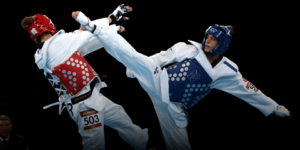
 Taekwondo is a Korean martial art whose name translates roughly as “the way of the foot and the fist” — tae (to strike with the foot), kwon (fist) and do (the way, or the art). It was formalised in Korea in the 1950s, drawing together older Korean fighting systems such as Taekkyon and Subak with influences from Japanese and Chinese arts, and has since grown into one of the most widely practised martial arts in the world. It is one of only two martial arts contested at the Olympic Games.
Technically, Taekwondo is best known for its kicking. The art makes full use of the legs’ reach and power, from the fundamental front, roundhouse and side kicks through to spinning, jumping and multiple-kick techniques. Alongside this sit hand strikes, blocks and stances that form the structural backbone of every technique; a strong front stance or back stance is what allows power to transfer through the body rather than leak away. Training is typically built around three pillars: poomsae, the set patterns of movements that encode the art’s core techniques and are practised solo; kyorugi, or sparring, where those techniques are applied against a live and unpredictable opponent; and fundamental drills and conditioning that develop balance, flexibility, timing and control.
Progress is marked by the coloured belt system, working through the geup (kup) grades toward black belt, and then through the dan grades beyond it. Each grading tests technique, poomsae, sparring and theory. Reaching black belt is often described not as an end point but as the beginning; the stage at which a student has learned the alphabet of the art and can start to use it properly.
What sets Taekwondo apart from a pure combat sport is its philosophical foundation. The five tenets- courtesy, integrity, perseverance, self-control and indomitable spirit, are not decoration. Self-control governs how hard you strike a partner; perseverance is what gets you back to training after a bad grading; courtesy shapes how you bow onto the mat and how you treat the person opposite you. The physical and the personal are trained together, and that is the point.